
You have a day job. On the side you run something: a candle shop on Etsy, weekend photography, a mobile coffee cart. This year it cost more than it brought in. The obvious question is whether that loss can come off the tax on your salary.
Sometimes it can. Often it can't, at least not this year. And the ATO lists this exact claim among its small business focus areas, because it is "seeing individuals incorrectly claim and offset losses from non-commercial business activities against other income sources".
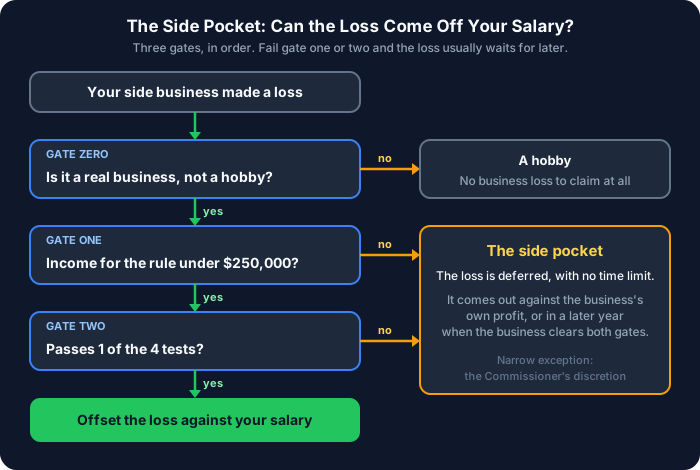
Here is the short version:
- First, it has to be a business. A hobby has no business loss to claim.
- Then two gates. Your income has to be under $250,000, and your business has to pass one of four tests.
- Fail a gate and the loss usually isn't lost. It generally waits until the business can use it, though a few rules can shrink or cancel it.
The side pocket
Think of every side business as having its own side pocket.
When the business makes a loss, the loss goes into that pocket. It only comes out against your salary if the business can show it is a real, commercial business. Until then it stays in the pocket and waits. It can come out later against the business's own profits, or in a later year when the business clears the bar.
The law that does this is Division 35 of the Income Tax Assessment Act 1997. The ATO calls the result a non-commercial loss.
The rules apply to individuals running a business as a sole trader or in a partnership. A loss made inside a company or a trust is dealt with under different rules, so this post doesn't cover it.
Gate zero: is it a business or a hobby?
Before any of the loss rules matter, the activity has to be a business. The ATO says the activity needs to be a legitimate business, not just a hobby. If it's a hobby, there is no business loss to put in the pocket at all.
No dollar figure decides this. Earning under $20,000 doesn't make something a hobby, and earning over it doesn't make it a business. The ATO weighs a set of indicators taken together. It lists them on its Are you in business? page and in TR 97/11, which says "no one indicator is decisive".
| Points to a hobby | Points to a business |
|---|---|
| Done for fun or relaxation | Done to make a profit |
| Now and then, when you feel like it | Regular and repeated |
| Sold to friends and family | Sold to the public |
| No records, mixed with personal money | Records and a separate account |
| Too small to ever make a profit | Big enough to make a profit |
| No plan | A plan or budget, run like a trade |
You also have to have actually started. Buying a shed and clearing a block is preparation; the ATO's own example says a business starts when the real activity does, such as planting pumpkins on a commercial scale.
The first of the ATO's most common errors on this topic is offsetting losses from hobby or other non-business-like activities.
Gate one: the $250,000 income requirement
To use the loss against your salary this year, the total of four amounts must be less than $250,000:
- your taxable income, ignoring the business loss itself
- reportable fringe benefits
- reportable super contributions, such as salary sacrifice and personal contributions you claim a deduction for
- total net investment losses, such as a negatively geared rental or share portfolio
Two of those catch people out. You can't use the business loss to drag yourself under $250,000, because the loss is added back. And salary sacrifice lowers your taxable income but is added back here too.
If you're over the line, the four tests below don't matter. The loss goes into the side pocket, and the only way out this year is the Commissioner's discretion, which is narrow (see below). The ATO names "problems applying the rules" above $250,000 as one of its most common errors.
Gate two: pass one of four tests
If you're under $250,000, the business has to pass at least one of four tests:
| Test | You pass if… |
|---|---|
| Assessable income | The business brings in at least $20,000 this year |
| Profits | It made a tax profit in 3 of the last 5 years, this year included |
| Real property | It keeps using land or buildings worth at least $500,000 |
| Other assets | It keeps using other assets worth at least $100,000 |
A few details sit behind that table:
- $20,000 means income, not profit. It counts the business's gross earnings excluding GST. A business with $25,000 of sales and a $10,000 loss passes this test.
- A part-year business can estimate. If you started partway through the year, you can make a reasonable estimate of a full year's income.
- The assets have to be used on a continuing basis. One-off jobs and short-term hire don't count.
- Assets are valued under the tax rules, not at what you paid. Equipment you depreciate counts at its written-down value, so a $120,000 machine written down to $60,000 counts as $60,000, and one written down to nil counts as nil.
- The real property test leaves out your home. A dwelling used mainly for private purposes doesn't count, and neither does the land next to it that goes with it.
- The other assets test leaves out cars. It counts things like equipment and trading stock, but not cars, motorcycles and similar vehicles.
Most side businesses can only realistically pass the first test, the $20,000 one. The other three suit businesses that are older or carry a lot of assets.
What happens to a loss that has to wait
If you fail a gate, you defer the loss. There is no time limit. It comes out of the side pocket when one of these happens:
- the business makes a profit, and the deferred loss is used against that profit
- the business passes the gates in a later year, and the loss can then be offset against your other income, along with that year's loss
- the Commissioner exercises the discretion
Deferred doesn't mean guaranteed, though. Three things can shrink or cancel what's in the pocket:
- The business stops for good. The deferred loss is effectively forfeited unless the same or a similar business starts again.
- You have exempt income. Net exempt income reduces the loss before it's deferred, and again in each later year.
- You become bankrupt. Bankruptcy, or a release from your debts under bankruptcy law, cancels losses deferred before it. They can't be used in that year or any later one.
A worked example
Assumptions. Illustrative only. Mia is a sole trader with no other investments, no reportable fringe benefits or super, and no exempt income. Year one is 2025–26. Her salary stays at $95,000, and we assume the 30% bracket plus the 2% Medicare levy applies in every year, as it does for 2025–26. The candle business is a genuine business from year one. Your figures will differ.
Mia is a nurse on $95,000. She also sells candles on Etsy, with a small workshop in her garage worth about $6,000.
Year one. Sales are $14,000 and costs are $22,000, so the loss is $8,000.
- Income requirement: $95,000 is under $250,000. She passes.
- Assessable income test: $14,000 is under $20,000. Fail.
- Profits test: no profit years yet. Fail.
- Real property and other assets: nowhere near $500,000 or $100,000. Fail.
So the $8,000 goes into the side pocket. Had she been able to claim it, it would have saved about $2,560 of tax (32% of $8,000). That saving is delayed, not cancelled.
Year two. Sales are $18,000 and costs are $19,500. That is another $1,500 loss, and she still fails all four tests. The pocket now holds $9,500.
Year three. Sales reach $26,000 and costs are $24,000. The business made $2,000 on its own, but the $9,500 from the pocket is counted against it, leaving a $7,500 loss. This time $26,000 clears the $20,000 test, so the $7,500 comes off her salary. At 32%, that is about $2,400 less tax.
| Year | Business result | In the pocket | Off her salary |
|---|---|---|---|
| 1 | −$8,000 | $8,000 | $0 |
| 2 | −$1,500 | $9,500 | $0 |
| 3 | +$2,000 | $0 | $7,500 |
Across three years the business lost $7,500 in total, and all $7,500 came off her salary in the end. She just got the tax back later than she wanted. This is the same pattern the ATO walks through in its own pie van example.
A second case: over the line
Tom earns a $265,000 package as an engineer. He salary-sacrifices $20,000 into super, so his taxable income is $245,000 and he thinks he's under $250,000.
He also runs a weekend photography business. It brought in $28,000 this year but cost $40,000, a $12,000 loss.
- His income for this rule is $245,000 plus the $20,000 of reportable super: $265,000. He fails the income requirement.
- His business passes the $20,000 assessable income test, but that no longer helps. Once the income requirement is failed, the four tests don't get him there. His only way out this year is the Commissioner's discretion, and for someone over $250,000 it is narrower still (see below).
The $12,000 goes into the side pocket. The ATO's own example is close to this: a consultant whose income for the rule was $251,000 claimed a $46,000 loss anyway, and was amended, with the tax to repay and possible penalties and interest.
The narrow exceptions
These are not loopholes. Each one is tight, and none suits a typical side business.
- Farmers and professional artists on low other income. If the business is primary production or a professional arts business, and your assessable income from other sources is under $40,000 (not counting net capital gains), you can use the loss straight away. A "professional arts business" has a technical meaning: an author of an original work (a photographer can be one), a performing artist, or a production associate. Tom's photography might count, but his $245,000 salary is far over $40,000.
- The Commissioner's discretion. You have to apply for it, and it has two limbs. Both are tighter than they sound, and both are tighter again above $250,000.
- Special circumstances. Something outside your control, such as a flood or bushfire, hit the business. Under $250,000, you need to show the business would have passed one of the four tests without it. Over $250,000, passing a test isn't the point (Tom already passes one). You need to show the circumstances caused the loss, in a business that would otherwise have made a tax profit.
- Lead time. Your type of business, not just yours, takes time before it can pass a test or make a profit. The ATO's example is a distillery whose spirit must age in oak casks for two years before it can be sold. You also need an objective expectation, backed by independent evidence where it exists, that the business will pass a test or make a tax profit within the period that's commercially viable for the industry. Over $250,000, only a tax profit counts. "My business is still growing" is not a lead time.
What to do before 2 November 2026
That is the deadline if you lodge your own 2025–26 return: 31 October falls on a Saturday this year, and a due date on a weekend moves to the next business day. A registered tax agent can often lodge later, but only if you're on their books in time. The ATO says to contact a new agent before 31 October to join their lodgment program. Hiring one on 1 November doesn't buy you an extension. The steps below are the same either way.
- Check gate zero honestly. Would the Are you in business? indicators read as a business? If you're not sure whether you've started yet, our starting a business tool walks through the steps.
- Add up the four amounts for the $250,000 line. Include salary sacrifice, fringe benefits and any negative gearing. Don't subtract the business loss.
- Check the $20,000 test against gross income, excluding GST, before you look at the other tests.
- If you fail, defer the loss rather than claiming it. Keep a running record of the side pocket each year so you can use it later.
- Review last year too. If you offset a loss you should have deferred, ask your tax agent about amending that return.
If you drive for Uber or deliver for a platform, the gig economy tax guide covers the ABN, GST and deduction rules that sit alongside this. And if you want to know how the ATO actually spots these claims, see what the ATO can already see about you.
When to get an accountant involved
- You're close to $250,000 once salary sacrifice, fringe benefits and investment losses are added. The arithmetic is where the ATO says people go wrong.
- You run more than one side activity. Similar activities can be grouped for the tests and different ones can't, and that call changes the answer.
- You're in a partnership. The partnership rules apply the tests differently to each partner.
- You think you qualify for the Commissioner's discretion. An application needs evidence, and a weak one only delays the answer.
- You've already claimed losses you shouldn't have. In the ATO's own example, the amended return came with tax to repay and possible penalties and interest. The ATO is also chasing small business harder in general; see the ATO's $105 billion debt book.
Bottom line
A side business loss can reduce the tax on your salary, but only once the business has proved itself. It has to be a real business. Your income for the rule has to be under $250,000. And the business has to pass one of four tests, which for most side businesses means $20,000 of income.
If it can't, the loss goes into the side pocket. Usually it isn't lost. It waits there until the business can use it, unless the business stops for good, exempt income eats into it, or you go bankrupt.
Sources
- ATO, What is a non-commercial loss?
- ATO, Non-commercial business loss risks (small business focus area)
- ATO, Offset or defer the loss – individuals or sole traders
- ATO, The income requirement
- ATO, Four tests
- ATO, How to defer your losses
- ATO, How to offset your losses
- ATO, Excepted business activities
- ATO, Commissioner's discretion, including special circumstances and lead time
- ATO, Similar business activities
- ATO, Offset or defer the loss – partnerships
- ATO, TR 2001/14 Income tax: Division 35 – non-commercial business losses, paragraphs 32–33, 64A–67 and 115–118
- ATO, TR 2007/6 Income tax: non-commercial business losses – Commissioner's discretion, paragraphs 13–25
- ATO, Lodge your tax return with a registered tax agent
- ATO, Lodgment and payment dates on weekends or public holidays
- ATO, Are you in business?
- ATO, TR 97/11 Income tax: am I carrying on a business of primary production?, paragraphs 13–17
This article is general information only, not personal financial or tax advice. Speak to a registered tax agent or accountant about your situation before claiming or deferring a business loss.


