
The tenants have moved out. The walls are scuffed, a window is cracked, the kitchen looks tired, and the shower has leaked since the day you bought the place. You get three quotes, pay about $27,000, and get the place back on the market.
Come tax time, most landlords put all of it in the repairs box. That is the mistake. Only a small part of that $27,000 is an immediate deduction. Most of the rest comes back at 2.5% a year over 40 years, and some of it does nothing for you until you sell.
The ATO knows this is where landlords slip. In its 2024 tax-time focus areas it said: "We often see landlords making mistakes when it comes to repairs and maintenance deductions on rental properties." Its random enquiry program has found that 9 out of 10 tax returns reporting rental income contain at least one error.
This post covers how the ATO sorts the spend, the one question that does most of the sorting, and the redraw habit that quietly shrinks your interest claim.
Three boxes, not one
Every dollar you spend fixing up a rental property ends up in one of three boxes.
A repair fixes wear, tear or damage that happened while the property was rented. A tenant scuffs the walls, a storm cracks a window, a fence panel blows over. You put it back the way it was, and you deduct the full cost in the year you incur it. Maintenance works the same way: repainting faded walls, oiling a deck, cleaning a pool.
An improvement makes something better than it was. The ATO's test is whether the work makes part of the property "better, more valuable, more desirable" or changes its character. A new kitchen, a remodelled bathroom, a brick feature wall where there used to be fibro. Improvements are capital. Structural ones are claimed as capital works deductions, generally at 2.5% a year over 40 years. A new appliance is a depreciating asset, claimed over its effective life.
An initial repair fixes damage or a defect that was already there on the day you bought the property. It does not matter whether you knew about it. It is capital too, so it is not immediately deductible as a repair. Eligible work on the building itself, such as a roof or a ceiling, is generally claimed as capital works at 2.5% a year, starting once the work is finished and the property is rented or genuinely available for rent. That can include the year you do the work. An initial repair to an existing depreciating asset, such as fixing an oven that was already broken, is not deductible as a repair. Buying a brand-new replacement is different: a new asset can be depreciated. The cost also goes into your capital gains tax (CGT) cost base for when you sell, reduced by any capital works you claimed (or could have claimed) on it.
| Repair | Improvement | Initial repair | |
|---|---|---|---|
| What | Fixes wear or damage from renting | Makes it better, or replaces a whole item | Fixes a defect there when you bought |
| Claim | All of it, this year | 2.5% a year for 40 years. New appliances: over their life | Not as a repair. Eligible building work: 2.5% a year. Also in the CGT cost base |
| e.g. | Painting walls the tenant scuffed | A new kitchen | A roof that leaked when you bought |
The trap in the third column catches people who assume "initial repair" just means "added to the cost base and forgotten". For work on the structure, the ATO's own example shows a landlord claiming a ceiling repair as capital works, even though the damage was there when she bought.
The settlement-day photo
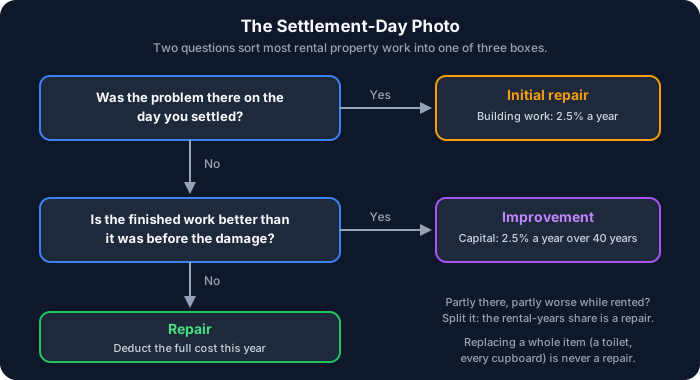
Here is the test that sorts most of the spend. Picture a photo of the property taken on the day you settled.
- Is the problem in that photo? Then the fix is an initial repair, however obvious or hidden the problem was.
- If not, does the finished work look better than the property did before the damage? Then it is an improvement.
- If not, and you have only put back what the tenancy wore out, it is a repair.
That is the settlement-day photo. The repair box is only for damage that happened on your watch, fixed back to how it was.
One refinement. Some problems are partly in the photo and partly not. Gradual wear that started before you bought and kept going while you rented can be split on a reasonable time basis, and the share from your rental years is a repair (TR 97/23, paragraphs 63 to 66). If the defect was already fully formed on settlement day, there is nothing to split.
"Better" is narrower than it sounds. The ATO accepts a modern equivalent material as a repair. Replacing a damaged fibro wall with plasterboard restores the wall without changing its character, so it is a repair. Replacing it with a brick feature wall is an improvement. A small, incidental improvement that comes with a genuine repair does not change the answer either.
A worked example
What this example assumes. Priya bought a 2009-built unit in 2021 and has rented it out ever since, on commercial terms, as an investment rather than a business. The building inspection at purchase flagged a leaking shower recess, which she never fixed. She pays tradespeople, not her own labour. Every trade gives her an itemised invoice. The shower's failed waterproofing was fully formed when she bought, and nothing about it got separately worse during her tenancies, so none of the $4,500 is split off as a repair. The $18,000 kitchen is cabinetry, benchtops and building work only; any new appliances are separate depreciating assets and are not in that figure. The finished property is advertised for rent again in the same income year. Change any one of these and the answer changes.
After the last tenants leave, Priya spends $26,900:
| Work | Cost | Box and claim |
|---|---|---|
| Repaint scuffed walls | $3,800 | Repair: $3,800 now |
| Two cracked window panes | $600 | Repair: $600 now |
| New kitchen and stone benchtops | $18,000 | Improvement: $450 a year |
| Fix shower that leaked at purchase | $4,500 | Initial repair: $112.50 a year |
So of $26,900, Priya deducts $4,400 this year, plus $562.50 of capital works for each full year the property is rented (less in the first year, which is pro-rated from when the finished property is rented or genuinely available for rent, not simply from the day the trades leave). The rest comes back to her slowly, or as a smaller capital gain when she sells.
Two details decide whether this works.
First, the itemised invoices. If one builder had done the painting and the kitchen on a single lump-sum invoice, Priya could only deduct the painting if she could separate its cost from the kitchen's. The ATO's advice is to ask for an itemised invoice before the work starts.
Second, the cost base. When Priya sells, the $18,000 kitchen and the $4,500 shower go into her CGT cost base, but she must reduce it by the capital works deductions she claimed or was entitled to claim. The deductions are not a bonus on top. They are the same dollars, just claimed earlier.
Where people get caught out
Replacing a whole thing is not a repair. Repair is fixing part of something. Replacing the entire item, which the ATO calls an "entirety", is capital. The ATO's example is a toilet damaged after 10 years of renting. Replacing the whole toilet is claimed as capital works, not as a repair. The same goes for replacing every kitchen cupboard, even with the same design.
Second-hand appliances bought with the property. If you entered into the contract to buy a residential rental property (or otherwise acquired it) after 7:30 pm on 9 May 2017, you generally cannot claim depreciation on the appliances, carpets and curtains already in it. A newly built or substantially renovated property can be an exception, but only if no one was previously entitled to a deduction for the asset and either no one lived there before you acquired it, or you acquired it within 6 months of it being built or renovated. Assets acquired before the cut-off, businesses of letting properties and some entities are also outside the rule. Otherwise, the assets you can depreciate are the new ones you buy. This is the settlement-day photo again: if it was in the photo, it is probably second-hand.
Your own labour. If you repaint the walls yourself over a weekend, you can claim the paint and materials, not the value of your time.
Holiday homes. If the property is also your holiday home, none of this helps unless you use or hold it mainly to earn rent. We cover that test in the ATO's new holiday home rules and the older available-for-rent trap.
The redraw trap
The renovation has to be paid for somehow, and this is where the interest claim quietly shrinks.
The rule is simple. Interest is deductible according to what the borrowed money was used for, not what the loan is secured against or what the bank calls it. Money used to buy the rental, to fix it, or to renovate it carries deductible interest. Money used for a car, a holiday or a new home does not, even if it is drawn from the investment loan.
Say Priya's investment loan sits at $380,000, and she is ahead on repayments. She redraws $27,000 for the renovation, which is fine. While she is at it, she redraws another $15,000 for a family holiday. The loan is now $422,000.
What this assumes. One loan account. Both redraws happen on the first day of the income year, the 6% rate holds all year, and the balances do not change (no repayments, no other redraws). A real year with repayments or mid-year redraws needs the ATO's accepted method in TR 2000/2, which works month by month from opening and closing balances.
| Part of the loan | Amount | Interest | Claim? |
|---|---|---|---|
| Original loan | $380,000 | $22,800 | Yes |
| Renovation | $27,000 | $1,620 | Yes |
| Holiday | $15,000 | $900 | No |
The holiday is about 3.6% of the loan, so about 3.6% of every interest bill is now private. Losing $900 of deductions is the small part. The bigger part is that the split sticks. While it stays one mixed-purpose account, every repayment is applied across the private and rental parts in proportion. Priya cannot direct her extra repayments at the holiday portion to get back to a clean loan. The ATO does accept one way out: refinancing the mixed balance into two separate loans that exactly match the rental and private parts. Interest on the rental loan is then deductible, and repayments on the private loan no longer touch it.
Refinancing works the same way. If you refinance a rental loan and take extra cash out for private use, the interest on that extra is not deductible, from the day you refinance. And if you borrow against the rental to buy a new home you live in, none of that interest is deductible, because the money bought a home, not an income-producing property.
The usual fix is to keep private money out of the investment loan entirely: pay for the holiday from savings or a separate loan, so the investment loan holds only investment borrowing. Talk to your lender and your accountant before you redraw, not after.
What to do before 2 November
If you lodge your own return, the usual deadline is 31 October. This year that falls on a Saturday, so under the ATO's next-business-day rule you have until Monday 2 November 2026. Before you lodge:
- Sort every invoice into the three boxes using the settlement-day photo. If one invoice mixes a repair and an improvement, ask the trade to split it.
- Dig out the building and pest report from your purchase. Anything it flagged and you have since fixed is likely an initial repair, unless part of the damage got worse while you were renting.
- Check your loan statements for redraws. List each one, what the money was spent on, and the date. If any of it was private, your interest claim needs splitting from that date.
- Get a capital works report if you don't have one. If you can't find the original construction costs, a quantity surveyor can estimate them, and their fee is deductible.
- Run the numbers. Our negative gearing calculator shows what the property really costs after tax, and the rental yield calculator shows whether the renovation earns its keep in rent.
When to get an accountant involved
Get advice if the work touched most rooms of the property, because a substantial renovation changes the rules again. Also get advice if you have redrawn or refinanced more than once for mixed purposes, if you turned your former home into a rental, or if you have claimed big repairs in past years that, on reflection, were improvements or initial repairs. What to do about past years depends on the amounts and your facts, and that is worth working through with someone before you change anything.
Bottom line
The repairs box is smaller than most landlords think. It holds only damage that happened while the place was rented, put back the way it was.
Anything that was there on settlement day is an initial repair. Anything that leaves the place better is an improvement. Neither is an immediate deduction. Eligible building work comes back at 2.5% a year instead.
And watch where the money for the work comes from. Interest follows the money, so one private redraw from the investment loan splits your interest claim for as long as that account stays mixed.
Sources (all ato.gov.au): Repair and maintenance expenses (updated 22 May 2026); Capital expenses (updated 21 May 2026); Work out your capital works deductions (updated 22 June 2026); Depreciating assets in rental properties (updated 21 May 2026); Second-hand depreciating assets (updated 22 June 2026); Interest expenses (updated 21 May 2026); TR 97/23 Income tax: deductions for repairs; TR 2000/2 Income tax: deductibility of interest on moneys drawn down under line of credit facilities and redraw facilities; Rental properties guide, Certain second-hand depreciating assets; Lodgment and payment dates on weekends or public holidays (updated 1 July 2026); ATO media releases of 20 July 2022 and 6 May 2024.
This article is general information only, not personal financial or tax advice. Tax rules can be complex and individual circumstances vary. Speak to a registered tax agent or accountant about your specific situation.


