
Pay a BAS late and the ATO charges interest on it every day. That interest is the general interest charge, or GIC. Plenty of business owners treat it as negotiable: ring the ATO, explain it was a hectic quarter, and ask them to wipe it.
That still works sometimes. But over the past year the ATO has changed how these requests are handled, and it has spelled out in writing what it says yes and no to. Here is the short version:
- It is not autopilot. Bigger requests now go to a dedicated review team, not a quick phone call. A person still decides. They decide from a form and from the ATO's own records about you.
- "I was busy" is not a reason. It describes something within your control. Cash flow trouble, a slow economy and customers paying late are on the ATO's "likely to decline" list too.
- Your history does the heavy lifting. The ATO says a late payment that is out of pattern with years of paying on time is viewed more favourably. For GIC of about $2,500 or less, a good record will "strongly influence" the decision.
The late note
Think back to school. If you turned up late, the office wanted a note.
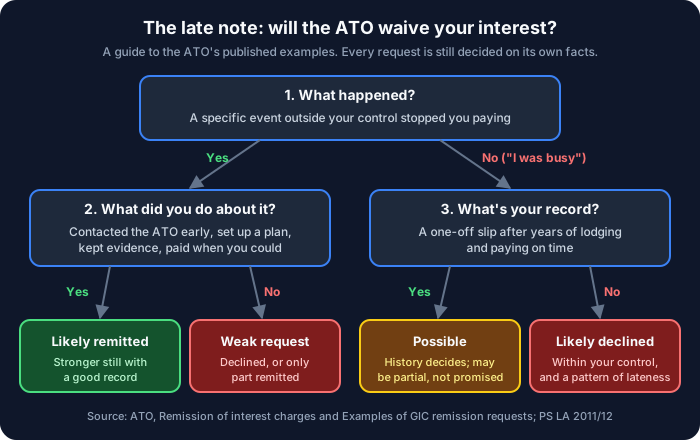
A note from home worked when it did three things. It named something that actually happened, like a flat tyre or a doctor's appointment. It showed you couldn't help it. And it came from a kid who was normally on time. "I slept in" was not a note. Neither was a perfect note from a kid who was late every Monday.
That is the late note principle, and it is now close to how the ATO decides a GIC remission request. The ATO asks for:
- What happened. The specific event, and how it stopped you paying by the due date. That includes how likely it is you would have paid on time if it hadn't happened.
- Whether you could help it. Whether the delay was outside your control, and what steps you took to reduce the damage.
- Your record. Your lodgment and payment history over the last several years.
Your record is the part you can't write on the day. You build it every quarter, long before you ever need a note.
What changed in 2026
The ATO started reviewing its "taxpayer relief" settings in March 2025. That review covers interest remission, penalty remission, deferrals and payment plans. In September 2025 it asked for feedback on five draft principles: fairness, conditionality, context, engagement and exclusions.
The same release shows how often the answer used to be yes. In 2024–25 the ATO received over 125,000 requests to remit GIC and granted over 95,000 of them, or 76%.
Then the Tax Ombudsman reviewed how the ATO manages GIC remission. On 2 March 2026 the ATO responded to that report. It agreed with all 10 recommendations and listed the changes it had already made:
- Published examples of requests it is likely to accept and likely to decline.
- New application forms that walk you through the information and evidence it wants.
- A $2,500 cap on phone approvals. Above that, a phone request is escalated and you won't get an answer on the call.
- A dedicated review team for requests over $2,500, to make decisions more consistent.
The ATO's own reason for the phone cap was "reducing the risk of inconsistent decision making". That is the real shift. A remission could once be settled in a phone conversation. Now, above $2,500, it depends on what you can put in writing.
Two more things are worth knowing:
- The ATO checks its own data. Its request page says it can use what is on its systems, including your lodgment and payment history and assets you own such as property, vehicles, boats and shares. If you say you couldn't pay, expect the ATO to look at whether you could have.
- It is still interim. The ATO describes these as interim changes while its broader review continues. Its main policy on GIC remission, PS LA 2011/12, carries a note that it is being reviewed. More changes may come.
What the ATO says yes and no to
The ATO's examples page lists the situations it sees most. Every request is still decided on its own facts. But the two lists are clear, and several items come in pairs that look alike and land on opposite sides.
| Likely to be accepted | Likely to be declined |
|---|---|
| A major customer collapses unexpectedly, owing you money | Late payment of invoices, as a general business risk |
| A natural disaster such as fire, flood or drought hits you or your tax agent | A general economic downturn, rising costs or rising interest rates |
| Sudden ill health of the owner or a key person in a small business, which actually stopped the payment | A director falls ill but the business keeps trading, paying suppliers and running payroll |
| Theft of, or damage to, property the business can't run without | Spending the money on expanding the business instead of paying the tax |
| Family and domestic violence, financial abuse, coercive control or other vulnerability | Being on holiday when the payment was due |
| Bereavement of a family member | Not giving your tax or BAS agent enough time to meet the deadline |
| Industrial action affecting you or your agent | Currency or exchange rate movements |
"I was busy" doesn't appear on either list. It belongs with the right-hand column. It describes your own choices about time, so it fails the second question of the late note before anyone reaches the third.
Look at the illness pair. Illness is on the "likely to accept" list, but the ATO declined a company whose director was sick for four months. Sales didn't drop, the other directors kept running things, invoices and payroll were paid, and the company had a history of paying late. The event was real. It just didn't explain the missed payment.
Fault isn't the whole story
There are four legal routes to remission in PS LA 2011/12. The one most people expect is that the delay wasn't your fault and you took reasonable steps to limit it.
The other routes matter for ordinary business owners:
- It was your fault, but you took reasonable steps and remitting is fair and reasonable. You still need to show you took reasonable steps to limit the circumstances or their effects. Fairness alone isn't enough. The fairness test is whether ordinary members of the community who pay on time would see it as fair. The practice statement gives the example of a soundly advised decision that had unforeseen, severe consequences, where you had a plan in place to pay on time.
- Special circumstances. The practice statement's example is a taxpayer with a consistently good payment record who is late on an isolated occasion.
That second route is why a good record can rescue a request that has no dramatic event behind it. The excuse didn't earn that remission. The history did.
The ATO can also remit only part of the GIC when full remission isn't justified.
A worked example: Mia's late BAS
Assumptions. Mia owes $20,000 on her July–September 2026 BAS, due Wednesday 28 October 2026, with no extension for lodging online. She lodges on time but pays 90 days late, on 26 January 2027. GIC is charged at 11.51% a year, the October–December 2026 rate, compounding daily, for the whole 90 days. In reality the days from 1 January 2027 take the January–March 2027 rate, which hadn't been published when this was written. Penalties are ignored. Figures are rounded.
Mia runs a café. At 11.51% a year, the daily rate is about 0.0315%. Over 90 days, compounding daily, her GIC comes to about $576.
That $576 is a real cost. GIC incurred from 1 July 2025 can't be claimed as a tax deduction, so nothing comes back at tax time.
Now three versions of Mia's request:
Version 1: "It was a flat-out quarter and cash was tight." Tight cash flow and a busy period are both within her control, and adverse business conditions are on the "likely to decline" list. She is likely to pay the full $576.
Version 2: a big customer went under. In September, a catering client that owed her $15,000 went into receivership. Mia rang the ATO before 28 October and set up a payment plan. She has paid every BAS on time for five years. This closely matches the ATO's own example of a plumbing business whose major client went into receivership. In that example the business set up a three-month payment plan before the due date, asked for remission once it was paid, and the GIC was remitted. Mia's request is likely to succeed. She sends the receivership notice and her payment plan details.
Version 3: no event, but a clean record. Nothing went wrong. Mia simply missed it, for the first time in five years. There is no event to point to, so the special circumstances route is the one that could help her. Because her GIC is under $2,500, the ATO says her good history will "strongly influence" the decision. It is possible, not guaranteed, and it may be partial.
What a remission can't recover, in any version:
- The $20,000 itself. Remission only touches the interest.
- A late lodgment penalty. Failure-to-lodge penalties are a separate request.
- The size of the hole if she waits. Leave the same debt for a full year at the same rate and the GIC is about $2,439. That is close to the $2,500 line, above which a phone call can't approve it.
Engaging early still buys you something
In almost every "likely to accept" example, the business did something early. It contacted the ATO before the due date, set up a payment plan, filed a police report or lodged an insurance claim. In the declined examples, the taxpayer often didn't contact the ATO at all.
A payment plan doesn't stop the interest. The ATO says plainly that debts on a payment plan keep accruing GIC, compounding daily. What a plan buys you is evidence. It shows you took reasonable steps, which is the second question of the late note. If you owe $200,000 or less, you may be able to set one up online.
If the ATO says no, your options are narrower than you might expect. You can't object to a GIC remission decision or take it to the Administrative Review Tribunal. If you left out a key piece of information, or think the ATO made a particular error, you can send a new request. Beyond that, the only route is judicial review in the Federal Court. So put everything in the first request.
What "real time" means for your month
The ATO's 2026–27 corporate plan lists "enabling a move to real time taxation" as a priority. It isn't one switch. It is a set of shorter deadlines and tighter links between your software and the ATO. Each one is another entry in the record the ATO reads when you ask for help.
Your BAS, on time, every time. This is the single best thing you can do for a future remission request. Every on-time BAS is a line in your history.
PAYG instalment variations. You can vary your instalments if you expect a lower tax bill. If your varied instalments end up below 85% of the tax you actually owe, GIC can apply to the difference. It won't if you took reasonable care to estimate. The practice statement also says GIC on unpaid instalments isn't remitted just because your final tax came in lower.
Dynamic PAYG instalments, from July 2027. In the May 2026 Budget the Government announced that from 1 July 2027 businesses can opt in to an ATO-approved instalment calculation built into their accounting software. It will match instalments to how the business is actually performing. The ATO is running pilots during 2026–27, and its corporate plan commits to expanding the dynamic PAYG instalments pilot. A draft guideline, PCG 2026/D3, says the ATO won't spend resources applying or collecting GIC on excessive variations if you use the method as intended. The same announcement said businesses with a history of non-compliance will have to report and pay instalments monthly. These measures are not yet law.
Payday Super. Since 1 July 2026, super guarantee contributions must reach your employees' funds within 7 business days after each payday, not quarterly. There are some exceptions, such as for new employees. If late super leaves you owing the super guarantee charge, don't count on the interest being waived. The practice statement says remitting GIC on that charge will often be hard to justify as fair and reasonable, because it is collected on behalf of your employees.
What to do before 1 March 2027
Your October–December 2026 quarterly BAS is due on 28 February 2027. That is a Sunday, so you have until Monday 1 March 2027.
- Pay the September quarter if it is still outstanding. GIC is running at 11.51% a year, compounding daily, and you can't deduct it.
- If you can't pay, contact the ATO before the due date. Set up a payment plan and keep the confirmation.
- Write down what happened while it is fresh. Dates, amounts, the customer who collapsed, the insurance claim, the medical certificate. You'll need it if you ask for remission later.
- Use the ATO's form. Businesses can phone, mail or use online services. If you apply online, the GIC remission application form is an Excel file and must be submitted in that format. Download a fresh copy each time, because the ATO updates it.
- Set up a tax account. Move GST, withholding and super into it every pay run, so the money is there when the deadline comes.
When to get an accountant involved
- Your GIC is over $2,500. The request goes to a review team and will be decided on what you put in writing.
- Your story is mixed. For example, a real event plus some late payments in earlier years. How you show the link between the event and the missed payment matters.
- You have a pattern of late payments. You may need a plan to rebuild your record before remission is realistic.
- Super, withholding or director penalties are involved. Unpaid super and PAYG withholding carry consequences well beyond interest.
- You are thinking about varying PAYG instalments or joining the dynamic PAYG pilot. An estimate that is too low can cost you GIC.
Bottom line
The ATO hasn't put remission on autopilot. It has put it on paper. Bigger requests now go to a review team that reads a form, your evidence and the ATO's own records about you.
Think of the late note. Name what happened. Show you couldn't help it and what you did about it. And have a record that makes the note believable. "I was busy" fails at the first two. Your record is the only part you can't write after the fact, so build it every quarter.
Sources
- ATO, Remission of interest charges, last updated 22 January 2026
- ATO, Examples of GIC remission requests, last updated 22 January 2026
- ATO, How to request a remission of interest and failure to lodge penalties, last updated 14 July 2026
- ATO, ATO response to Tax Ombudsman's review of ATO's management of GIC remission, 2 March 2026
- ATO, ATO seeks feedback on selected taxpayer relief provisions, 4 September 2025
- ATO, PS LA 2011/12 Remission of general interest charge
- ATO, General interest charge (GIC) rates
- ATO, General interest charge
- ATO, Payment plans and Setting up a payment plan
- ATO, How to vary your PAYG instalments
- ATO, Dynamic pay as you go instalments – making tax simpler for businesses, 12 May 2026
- ATO, Dynamic PAYG instalments are coming – have your say, last updated 10 July 2026
- ATO, Corporate plan 2026–27: our priorities for 2026–27
- ATO, About Payday Super
- ATO, Due dates for lodging and paying your BAS
This article is general information only, not personal financial or tax advice. The ATO describes its current remission process as interim while its review continues, and the dynamic PAYG instalment measures are not yet law. Speak to a registered tax agent or accountant about your situation before asking the ATO to remit interest.


