
You're a doctor, a lawyer, an accountant, an engineer or a consultant. Your fees go into a family trust or a company, and at the end of the year some of the profit goes to your spouse and your adult children, who pay less tax than you. It's a common set-up, and it often started on an adviser's recommendation years ago.
The ATO has now said, in writing, how it sees that split. In November 2025 it published PCG 2025/5, and its message is blunt: passing a personal services business test "does not mean that the PSB is legally entitled to divert or retain" your income to cut your tax. It also gave people a window. The ATO says you "should not be concerned" that it will pursue the anti-avoidance rules if you've made a genuine attempt to move into a low-risk arrangement by 30 June 2027.
Here is the short version:
- First, work out whose hands earned the money. If it's mainly your own skill and effort, it's personal services income, and splitting it with family usually fails or is high risk.
- If the business itself earns it, through staff, equipment and goodwill, a different ATO guideline scores your split green, amber or red.
- Either way, distributions to a spouse or adult child have a third test. If the distribution is part of an arrangement that benefits someone else, and it isn't ordinary family or commercial dealing, section 100A can tax it to the trustee at the top marginal rate.
Whose hands earned it
Think of the family trust as an envelope. You can write anyone's name on the front, and the trustee can post the money to your spouse, your kids or a company.
The ATO doesn't read the name on the envelope. It asks whose hands earned what's inside.
If the money is mainly a reward for your hands, your skill, your hours, your judgment, then it stays your personal services income no matter whose name is on the envelope. The tests in gate one then decide whether the law taxes it to you directly, or whether the split is left to the anti-avoidance rules. If it was earned by a business that would keep earning without you, through employees, equipment and a client list that belongs to the practice, then there's genuinely something to share, and the question becomes how much and why.
That is the whole post in one idea: whose hands earned it decides which rulebook applies.
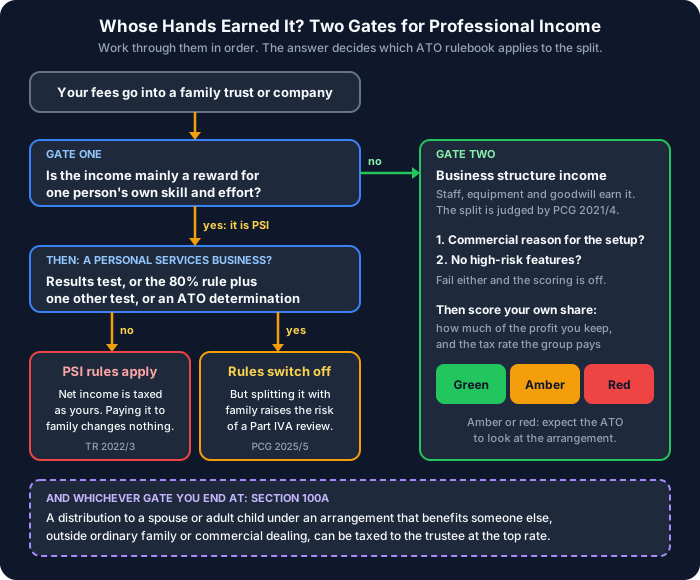
Gate one: is it personal services income?
Personal services income, or PSI, is income that is mainly a reward for an individual's personal effort or skill. "Mainly" means more than half. The ATO's own list of who commonly earns it includes financial professionals, IT consultants, engineers and medical practitioners.
Only individuals can earn PSI. Putting a company or trust in the middle doesn't change that. The ATO calls the company or trust a personal services entity. TR 2022/3 says working through an entity doesn't automatically make the income business structure income (paragraph 45), and PCG 2025/5 adds that running a business through it, or passing a test, doesn't either (paragraph 19).
Income is not PSI if it mainly comes from selling goods, using a significant income-producing asset, or a business structure. TR 2022/3 lists what points to a business structure (paragraph 44):
| Points to your hands | Points to a business structure |
|---|---|
| You do all the principal work | Employees do much of the work |
| No significant assets | Assets help earn the income |
| Clients come for you | Goodwill that would outlast you |
| Income stops if you stop | A size and scale beyond one role |
A big client list on its own isn't enough. In TR 2022/3's Example 8, three accountants practise through their family trusts with a wide client base and a service entity supplying staff and premises. Their income is still each accountant's PSI, because the firm has no substantial income-producing assets or employees of its own doing the work.
If it is PSI: are you a personal services business?
PSI isn't caught by the PSI rules if you're running a personal services business, or PSB. You can self-assess as a PSB in one of two ways:
- The results test, on at least 75% of your PSI. You're paid for producing a result, you supply the equipment and tools needed to do the work, and you're liable for the cost of fixing defects.
- The 80% rule plus one other test. Less than 80% of your PSI comes from one client and its associates, and you also pass one of these three:
| Test | You pass if… |
|---|---|
| Unrelated clients | 2+ unrelated clients came from offers to the public |
| Employment | Others do at least 20% of the principal work, by market value |
| Business premises | Separate business premises you use exclusively, all year |
Each test has fine print that TR 2022/3 spends paragraphs 77 to 148 on. Two points catch professionals:
- Being paid for your time is not producing a result. Custom in your industry can fill a gap in a contract, but it can't override the three conditions (paragraph 82). Being disciplined by your professional body doesn't count as liability for defects either (paragraph 93).
- The 80% rule looks at who is contractually obliged to pay you. Work through a labour-hire firm counts as coming from that firm, and it doesn't count as an offer to the public (paragraphs 69–70 and 98).
If you fail, you can apply for a PSB determination, but only in the circumstances TR 2022/3 lists (paragraph 152), such as unusual, temporary circumstances that stopped you passing a test you would otherwise have passed. An industry-wide downturn doesn't count (paragraph 156).
When the PSI rules apply
If you're not a PSB, three things happen to the company or trust (PCG 2025/5, paragraph 23):
- The net PSI is attributed to you and taxed in your return, whoever the trustee distributed it to.
- Deductions are limited. The rules stop claims you couldn't make if you'd earned the income as an employee.
- PAYG withholding obligations generally arise on the PSI.
In plain words: the envelope is ignored. The split doesn't save any tax.
When you pass a PSB test: PCG 2025/5
This is where many professionals had assumed they were safe. Passing a test switches off the PSI rules, but the income keeps its character as PSI, and the general anti-avoidance rule in Part IVA can still apply if the dominant purpose of the arrangement is a tax benefit. TR 2022/3 already said so (paragraphs 14, 75 and 160). PCG 2025/5 sets out how the ATO will decide who to look at:
| Lower risk | Higher risk |
|---|---|
| Net PSI taxed to you at your rate | Net PSI split with family on lower rates |
| Pay that matches the value of your work | Pay well below the value of your work |
| A spouse paid fairly for real admin work | A spouse or relative paid above their work |
| Profit kept briefly for a real business need | Profit kept and lent back to you, even on a complying loan |
The ATO's Example 16 is a lawyer whose trust earns $300,000 from his work. He takes $35,000 and the rest goes to family members on lower rates. That's higher risk, and the ATO says Part IVA may apply.
"Higher risk" is the ATO's term for a greater chance it will review the arrangement for possible Part IVA. It deliberately avoids "high risk", because it can't say in advance that Part IVA will apply (footnote 1).
Two things to hold onto. PCG 2025/5 says it "does not establish a 'safe' level of PSI diversion" (paragraph 41), although the ATO is more likely to go after substantial amounts. And the 30 June 2027 window is not an amnesty: the ATO says it will continue to review some higher-risk arrangements in the meantime, and the window doesn't undo past assessments.
If your company keeps profits and lends them back to you, the loan has its own rules too. See Division 7A, explained.
Gate two: when the business earns it
If the practice's income really comes from its structure, the PSI rules and PCG 2025/5 don't apply. The ATO points you instead to PCG 2021/4, its guideline on allocating professional firm profits (PCG 2025/5, paragraph 21). It covers firms in accounting, architecture, engineering, financial services, law, medicine and management consulting, among others.
Before you can score yourself, you have to pass two gateways:
- A commercial rationale. The structure and the way profits flow must be commercially driven, and you need evidence that the commercial purpose was achieved. Saying "asset protection" isn't enough if the structure doesn't actually protect assets (paragraph 41).
- No high-risk features. These include non-arm's length financing, exploiting differences between accounting and tax, assignments that depart from the Everett and Galland cases, and special classes of shares or units for people who don't own the firm.
Fail either gateway and the scoring isn't available to you.
If you pass, you score your arrangement on two factors (a third is optional). The scores come from paragraph 76:
| Your share of the profit | Score | Group's average tax rate | Score |
|---|---|---|---|
| Over 90% | 1 | Over 40% | 1 |
| Over 75% to 90% | 2 | Over 35% to 40% | 2 |
| Over 60% to 75% | 3 | 30% to 35% | 3 |
| 50% to 60% | 4 | Over 25% to under 30% | 4 |
| Over 25% to under 50% | 5 | Over 20% to 25% | 5 |
| 25% or less | 6 | 20% or less | 6 |
"Your share" means the share of the whole firm group's profit due to you and your associated entities that is taxed in your own hands. The tax rate is the average across that whole amount, not your marginal rate, and it leaves out the Medicare levy (footnote 6).
Add the two scores. 7 or less is green, 8 is amber and 9 or more is red. If you keep 100% of the profit, you're green without scoring.
Green means the ATO generally won't spend compliance resources testing the arrangement. Amber or red means it will generally conduct some form of compliance activity to understand it. That isn't a finding of avoidance. PCG 2021/4 says being in the red zone "does not necessarily mean Part IVA applies" (paragraph 37).
Where the kids come in: section 100A
The first two gates are about the split between you and your trust. Section 100A is about what happens after the trustee makes a family member presently entitled.
Under TR 2022/4, section 100A can apply when a beneficiary's entitlement comes out of an arrangement that:
- gives a benefit to someone other than that beneficiary
- has a purpose of someone paying less tax, and
- was not entered into in the course of ordinary family or commercial dealing.
If it applies, the trustee is taxed on that share at the top marginal rate (paragraph 3).
The ATO's PCG 2022/2 sorts common arrangements:
| Green zone (low risk) | Red zone (high risk) |
|---|---|
| An adult child is paid and uses it for themselves, a spouse or dependants | It repays a parent for costs from before age 18 |
| Paid within 2 years and used by the beneficiary | A non-resident relative lends or gifts it to a resident |
Both green scenarios apply only if none of the exclusions in paragraph 32 are present. Some things, such as a beneficiary gifting the money on, take an arrangement out of the green zone without putting it in the red one. Those arrangements sit in between, and the ATO looks at the facts.
The red-zone example in PCG 2022/2 (Example 14) could have been written for a professional family. Two adult children, both full-time students, are each made entitled to $120,000. Their parent has already spent the trust's money on household costs, booked as a loan to her. The children's entitlements are set off against that loan, on the basis that they owe her for education and household costs from before they turned 18, and she pays their tax. The ATO says it would look at that as a priority.
One status note. Both TR 2022/4 and PCG 2022/2 now carry a notice that they are being reviewed after the High Court's decision in Commissioner of Taxation v Bendel in June 2026. That case was about whether a bucket company's unpaid entitlement is a Division 7A loan. The ATO's response to it says section 100A may still apply to such entitlements, so treat the guidance above as current but under review.
The proposed 30% minimum tax on discretionary trusts from 1 July 2028 would change this arithmetic again. It isn't law yet; see the 30% family trust tax.
A worked example
Assumptions. Illustrative only. Figures are income tax at 2025–26 resident rates, before the 2% Medicare levy (which PCG 2021/4's scoring also leaves out) and any offsets. Everyone is an Australian resident with no other income. The trust's net income is $400,000 after practice costs. The children are adults, and every distribution is paid to the person named and used for them, with no arrangement benefiting anyone else, so section 100A is not in play. Your figures will differ.
Dr Priya is a GP. Her income goes into the Priya Family Trust, which has a company as trustee. Her husband Sam doesn't work in the practice, and their two children are at university.
The trustee is thinking about this split:
| Who | Share | Tax |
|---|---|---|
| Priya | $250,000 | $78,638 |
| Sam | $50,000 | $5,788 |
| Each child (two) | $50,000 | $5,788 |
| Family total | $400,000 | $96,002 |
If all $400,000 were taxed to Priya, the bill would be $146,138. So on paper, the split saves $50,136. Whether it works depends on whose hands earned the $400,000.
Version one: it's Priya's hands
Priya works only at one medical centre. Under the trust's contract, the centre itself owes the trust a fee for each session she works. It isn't just collecting her patients' fees and passing them on. The centre supplies the rooms, equipment and nurses, and the contract doesn't require her to bring any.
- Gate one. The income is mainly a reward for her skill. It's PSI.
- 80% rule. All of it comes from one centre, the entity contractually obliged to pay the trust. Fail, so only the results test is left.
- Results test. She's paid for sessions worked, not for a specified result, and isn't expected to supply the equipment. Fail.
The PSI rules apply. The trust's net PSI is attributed to Priya, and her tax is $146,138 whatever the trustee resolves. The split saves nothing.
Now suppose her set-up passed a PSB test instead. The PSI rules switch off, but the income is still her PSI, and paying $150,000 of it to a husband and children who did none of the work is the higher-risk pattern in PCG 2025/5. That makes an ATO review more likely. If Part IVA were applied, the $50,136 benefit would be cancelled, and penalties and interest could follow.
Version two: it's the practice's hands
Now Priya owns the clinic through the trust. It employs four other GPs, three nurses and a front desk, owns its fit-out and equipment, and has patients who stay when Priya is on leave. Her share of the profit, after paying everyone, is $400,000. That income comes from a business structure, so gate two applies.
Assume the trust passes both gateways. Then:
| Split | Priya's share | Group tax rate | Score | Zone |
|---|---|---|---|---|
| $250k / 3 × $50k | 62.5% (3) | 24.0% (5) | 8 | Amber |
| $310k / 3 × $30k | 77.5% (2) | 27.8% (4) | 6 | Green |
The first split is amber, so Priya should expect the ATO to take a look. The second is green. It still saves $34,836 a year compared with taking everything herself ($111,302 instead of $146,138), and the ATO generally won't test it. It still needs a documented commercial reason for the structure, and the children's distributions still mustn't be part of an arrangement that benefits someone else.
Same doctor, same $400,000, three different answers. The only thing that changed was whose hands earned it.
What to do before 30 June 2027
That's the date in PCG 2025/5 (a Wednesday). If you've made a genuine attempt to move a PSB into a low-risk arrangement by then, the ATO says you needn't be concerned it will pursue Part IVA. It's not a lodgment deadline and not an amnesty, and reviews of some higher-risk arrangements continue meanwhile.
- Answer gate one honestly, for each person. The tests apply to each individual whose PSI goes through the entity, not to the firm as a whole.
- If it's PSI and you pass a PSB test, check the split against PCG 2025/5. If any net PSI is diverted to lower-taxed family members or kept in the entity, review the arrangement now. PCG 2025/5 sets no safe level of diversion.
- If it's business structure income, score it. Work out your share and the group's average tax rate under PCG 2021/4, and write down the commercial reason for the structure. The ATO expects you to reassess this every year.
- Check what happened to each distribution. Was it paid to the beneficiary and used by them, or did it come back to you?
- Keep records as you go. PCG 2025/5 lists the contracts, timesheets, minutes and trustee resolutions it expects (paragraph 45).
When to get an accountant involved
- You're not sure which gate you're at. The line between your hands and the business's is a judgment call, and getting it wrong sends you to the wrong guideline.
- Your entity relies on a PSB test you've never documented. The results test and the 80% rule turn on contract terms and who pays you.
- Your PCG 2021/4 score is amber or red, or you can't pass the gateways.
- Adult children's distributions come back to the family pot. That is the red-zone pattern under PCG 2022/2.
- Your company holds retained PSI or has lent it back to you. That brings in PCG 2025/5's retention examples and Division 7A together.
Bottom line
A family trust doesn't change whose hands earned your income. If it's mainly your skill and effort, it's personal services income. Either the PSI rules tax it as yours, or, if you pass a test, the ATO now says in PCG 2025/5 that splitting it with family raises the risk of an ATO review under Part IVA. If the practice itself earns it, PCG 2021/4 scores your split, and keeping more of the profit in your own hands moves you toward green. And a distribution to a spouse or adult child must not be part of an arrangement that quietly benefits someone else.
The ATO has given professionals until 30 June 2027 to move into a low-risk arrangement. Use it.
Sources
- ATO, PCG 2025/5 Personal services businesses and Part IVA of the Income Tax Assessment Act 1936 (published 28 November 2025), paragraphs 11, 19, 21, 23–25, 40–41, 45, footnote 1 and Example 16
- ATO, General anti-avoidance rules and PSI
- ATO, TR 2022/3 Income tax: personal services income and personal services businesses, paragraphs 14, 37, 44–45, 62, 66–98, 152–162 and Example 8
- ATO, PCG 2021/4 Allocation of professional firm profits – ATO compliance approach, paragraphs 25, 31, 37–59 and 67–81, and footnote 6
- ATO, Assessing the risk: allocation of profits within professional firms
- ATO, TR 2022/4 Income tax: section 100A reimbursement agreements, paragraphs 2–5
- ATO, PCG 2022/2 Section 100A reimbursement agreements – ATO compliance approach, paragraphs 20, 22, 32–34 and Example 14
- ATO, Decision impact statement: Commissioner of Taxation v Bendel [2026] HCA 18, paragraphs 26–36
- ATO, Income that is PSI and Income that is not PSI
- ATO, Self-assessing as a PSB and Apply for a PSB determination
- ATO, How to attribute PSI
This article is general information only, not personal financial or tax advice. Speak to a registered tax agent or accountant about your structure before changing how your trust or company distributes income.


