
Almost everyone has an opinion about Bitcoin. Very few people can say what it actually is.
That is not a failure of intelligence. It is a failure of explanation — the subject is buried under jargon, hype, and people trying to sell you something. So this post explains Bitcoin the way I would explain it across a desk, in plain words.
Then it gets to the part that actually costs Australians money. What most people get wrong about Bitcoin is not the technology. It is that the ATO does not treat it as money at all.
What Bitcoin actually is
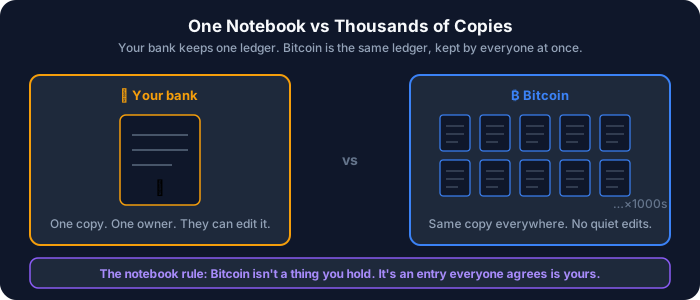
Imagine a notebook that lists every payment ever made between a group of people. Not balances — just lines. "Ana paid Ben 5." "Ben paid Cleo 2."
Now imagine that instead of one notebook locked in a bank's back office, thousands of computers around the world each keep their own identical copy. When someone makes a payment, every copy gets the new line. And once a line is written and enough copies agree on it, nobody can rub it out.
That is Bitcoin. It is a shared list of who paid whom, kept by everybody at once, that nobody can quietly edit.
Three things follow from that, and they are the only three you need.
Somebody has to add the pages. Adding a new page of transactions takes real computing work and real electricity. The people who do it are called miners, and they compete to add the next page. Whoever wins is paid in newly created Bitcoin. That reward is the whole reason anyone bothers.
Nobody can print more. The rules say only 21 million Bitcoin will ever exist, and the reward paid to miners shrinks over time on a fixed schedule. No committee can vote to make more. That is the biggest difference between Bitcoin and the dollars in your wallet — the RBA can change how many dollars exist, and does.
You do not really hold a coin. There is no file on your computer called "one bitcoin." What you hold is a secret key that proves a particular line in the notebook belongs to you. Lose the key and the line stays there forever, visible to everyone, and unreachable by anyone.
The notebook rule: Bitcoin is not a thing you hold. It is an entry that everyone agrees is yours. Every other quirk of how it works — and how it is taxed — comes back to that.
Why the price moves the way it does
The supply side is fixed by the rules. The demand side is people, and people change their minds.
When the amount of something cannot grow but the number of people who want it can double in a month, the price does exactly what you would expect: it moves hard, in both directions. There is no central bank smoothing it out, and no earnings report underneath it to anchor a valuation. The volatility is not a flaw someone forgot to fix — it is fixed supply meeting a variable crowd.
This post takes no view on whether Bitcoin is a good investment or where the price goes next. What follows is the part that is knowable: what happens on your tax return.
The part Australians get wrong: it isn't money
Here is the sentence that catches people out.
For tax purposes in Australia, crypto is not currency. The ATO treats crypto assets as CGT assets — closer to a parcel of shares than to the cash in your wallet.
That distinction sounds academic. It is not. It changes what counts as a taxable event. If you spend $50 of the cash in your wallet, nothing happens on your tax return. But if you hand over a parcel of shares, you have disposed of an asset, and the ATO wants to know what you paid for it and what it was worth when it left your hands.
The parcel rule: every time the parcel leaves your hands, the ATO sees a sale.
That means all of these are disposals:
- Selling Bitcoin for Australian dollars
- Swapping Bitcoin for Ethereum, or for any other crypto
- Using crypto to pay for something
- Gifting it to someone
Only the first one involves dollars. All four are taxable events.
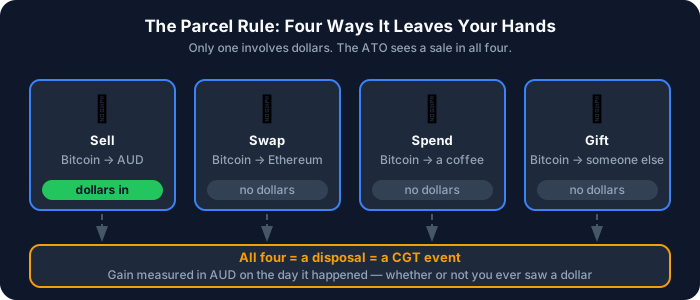
And because the gain has to be measured in dollars, you need the Australian dollar value on the day each transaction happened — not today's value, and not the value in US dollars. That is why record-keeping turns out to be the hard part of crypto tax, long after the investing part is over.
A worked example
Think of it like selling your bike to buy a scooter. You never touched cash, but you sold the bike. The ATO sees the sale.
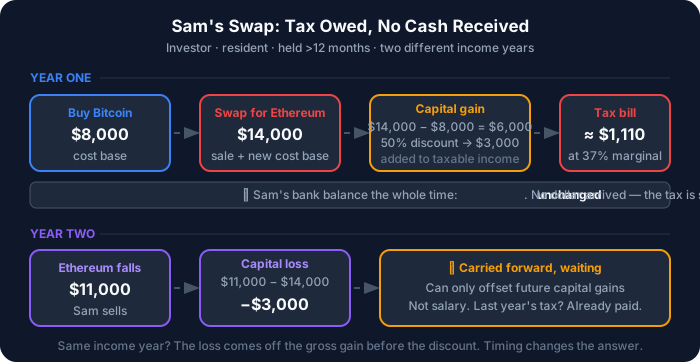
What this example assumes. The holder is an Australian tax resident for the whole period · holds as an investor, not carrying on a trading business · has no other capital losses to offset · held the parcel more than 12 months, so the 50% CGT discount applies · the crypto is not a personal use asset · the two events fall in different income years. Change any one of these and the answer changes.
Year one. Sam buys $8,000 of Bitcoin. That $8,000 is the cost base — what the parcel cost to acquire.
Eighteen months later, Sam swaps the whole parcel for Ethereum. At that moment the Bitcoin is worth $14,000. No dollars move. Sam's bank account does not change.
But a disposal has happened:
- Capital proceeds: $14,000
- Less cost base: $8,000
- Capital gain: $6,000
- Less 50% CGT discount (held over 12 months): $3,000
That $3,000 gets added to Sam's taxable income for the year. At a 37% marginal rate, that is roughly $1,110 in tax, before the Medicare levy — on a transaction where no money ever hit the bank.
The Ethereum now has its own cost base of $14,000, reset at the swap.
Year two. The Ethereum falls, and Sam sells it for $11,000. That is a capital loss of $3,000.
Here is the sting. A capital loss can only be offset against capital gains — not against salary. With no other gains that year, Sam carries the loss forward and waits. Meanwhile the tax on last year's $6,000 gain was already paid.
If both events had landed in the same income year, the maths would be different: the loss comes off the gross gain before the discount is applied. Timing matters more than most people expect.
The personal use exception (and why it probably isn't you)
There is a narrow exception for crypto held as a personal use asset — broadly, crypto you acquired and used to buy things for personal use, where it cost less than $10,000.
It is genuinely narrow, and it is not the escape hatch it looks like. The ATO's position is that the longer you hold crypto, and the more it looks like you are holding it because you hope it will go up, the less likely it is to be a personal use asset. If you bought it as an investment and it sat on an exchange for a year before you spent any of it, you are an investor and this does not apply to you.
Do not plan around it. For almost everyone reading this, the ordinary CGT rules are the rules.
When it's income, not a capital gain
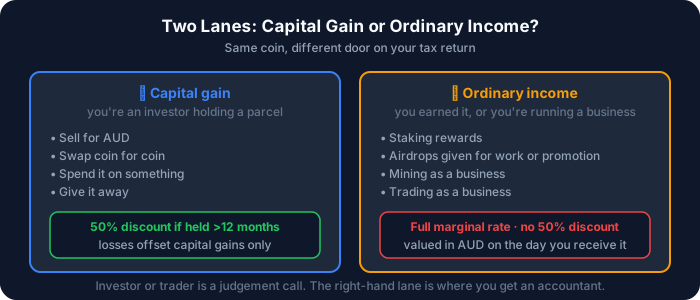
Not every crypto event is a capital gain. Some are ordinary income, taxed at your marginal rate with no CGT discount:
| Activity | Why it lands on the income side |
|---|---|
| Staking rewards | Treated as ordinary income at the AUD value when you receive it |
| Airdrops given for work or promotion | Income on receipt, valued in AUD that day. A free airdrop you did nothing for is not income; CGT applies when you sell or swap it |
| Mining as a business | Rewards are business income, and the crypto becomes trading stock |
| Trading as a business | Profits are ordinary income, not capital gains — no 50% discount, but losses may apply differently |
Each of these deserves its own post, and the boundary between "investor" and "trader" is a judgement call that turns on your specific facts. If you are in any of these four rows, this post is the beginning of the conversation, not the end of it.
Where people get caught out
| What people assume | What the rules say |
|---|---|
| "I only swapped coins, I didn't sell" | The swap is a disposal. Tax is due on the gain. |
| "I bought a coffee with it, that's spending" | Spending it is a disposal too. |
| "I never cashed out to AUD, so nothing to report" | The gain is measured in AUD whether or not you ever received AUD. |
| "The exchange keeps my records" | Exchanges close, get acquired, and cap how far back you can export. |
| "I lost the keys, so there's nothing to declare" | Possibly a capital loss you can claim — but only with evidence. |
That last row is the one people get backwards. A genuine loss can be worth claiming. It just needs proof.
What to do if you hold crypto
- List every exchange you have ever used — including ones you closed, and ones that no longer exist. The forgotten 2017 account is the one that causes problems.
- Export your full transaction history now. Platforms purge old data and limit export windows. This gets harder every year you leave it, not easier.
- Record the AUD value at the date of each transaction, not today's value. This is the single most common gap.
- Know your 12-month clock on each parcel. The difference between month eleven and month thirteen can be half the tax.
- Check what you have already lodged. If past returns did not mention crypto, work out where you stand before deciding what to do next — that is a conversation to have with an agent, not a form to quietly amend.
Worth knowing: the ATO already receives data directly from Australian crypto exchanges and matches it against returns automatically — the same machinery covered in What the ATO Can Already See About You. There is also an international framework (known as CARF) that could widen what is shared across borders if Australia legislates it, which is worth watching but is not law today.
When to get an accountant involved
Get advice if you have used more than one exchange, are missing chunks of your history, have staking or mining income, have moved to or from Australia during a period you held crypto (residency changes the answer — see the tax residency guide), or if you are unsure whether you count as an investor or a trader.
And particularly if past returns did not mention crypto you held. The options there depend on your facts, the amounts, and the timing, and the right move is genuinely different for different people. That is a conversation worth having before you do anything.
Bottom line
Bitcoin is simple to explain: a shared notebook nobody can edit, with a supply nobody can increase.
Where it gets expensive is that the ATO treats it as property you dispose of, not money you spend. Every sale, every swap, and every purchase made with it is a taxable event measured in Australian dollars on the day it happened — and you can owe tax on a gain without ever seeing a dollar of it.
If you hold crypto, the useful work is not predicting the price. It is knowing what you paid, what it was worth each time it left your hands, and being able to prove both.
This article is general information only, not personal financial or tax advice. Tax rules can be complex and individual circumstances vary. Speak to a registered tax agent or accountant about your specific situation.
