
"The only function of economic forecasting is to make astrology look respectable." — Ezra Solomon
I have this conversation with small business clients every single week. They feel the pain of rate hikes, but the mechanics behind them are completely opaque. This post is my attempt to explain it clearly — the way I'd explain it across my desk to a client who just asked, "why is this happening to me?"
I'm going to be honest up front: nobody has a clean answer to what's happening right now. Not the RBA, not Westpac's economists, not me. The best anyone can do is explain the forces at play, what the central bank is trying to do, and what it can and can't fix. That's what this post is.
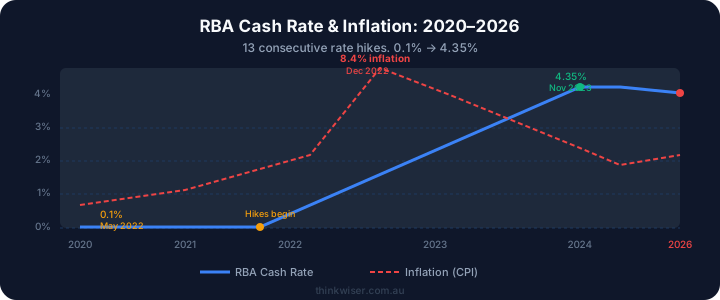
Between May 2022 and November 2023, the Reserve Bank of Australia raised interest rates 13 times over 18 months — from a historic low of 0.10% to 4.35%. Every mortgage holder in the country felt it. Most had no idea why it was happening, only that their repayments went up and their disposable income went down.
And now — because it's April 2026 and there's a war unfolding in the Middle East that's testing everything — we're about to do it all again. But for different reasons. Reasons the RBA might not even be able to fix.
First: What Is the RBA Actually Trying to Do?
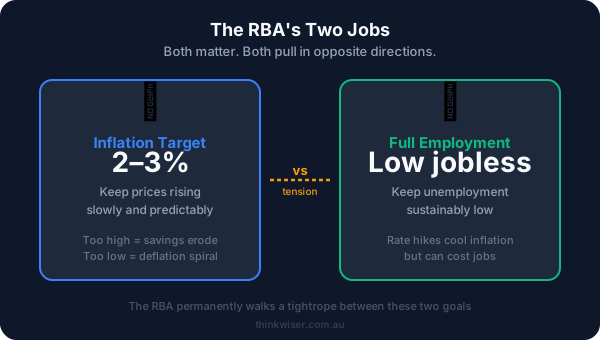
The Reserve Bank of Australia has two jobs. Not one, two.
Job 1: Keep inflation between 2% and 3% This means the prices you pay for things should rise slowly and predictably — enough to reflect a growing economy, but not so fast that your savings lose value or your wages can't keep up.
Job 2: Keep unemployment low A healthy economy should have people in jobs. The RBA tries to support conditions where businesses can grow and hire.
The catch? These two goals pull in opposite directions.
Raising rates fights inflation — but it also slows the economy and can push people out of work. Cutting rates creates jobs — but too much stimulus causes prices to spiral. The RBA is permanently walking a tightrope.
The Simple Story: When Rate Hikes Work
Imagine the Australian economy is overheating. Wages are rising fast, people are spending freely, and businesses are competing for the same limited goods. Too much money is chasing too few products. Prices go up.
This is demand-driven inflation. The RBA's response makes intuitive sense:
- RBA raises the cash rate (the interest rate banks pay to borrow from each other overnight)
- Banks raise their mortgage and lending rates
- Homeowners suddenly pay $500–$1,000 more per month on their mortgage
- Less money left over for restaurants, holidays, new TVs
- Demand falls. Businesses can't raise prices as easily. Inflation cools.
In Australia this mechanism works particularly fast. The vast majority of Australian mortgages are variable-rate — around 80% after the pandemic-era fixed-rate cliff rolled off — meaning a rate hike passes through to household budgets within weeks. Compare that to the US or UK, where most mortgages are fixed for 5–30 years and rate hikes can take years to bite.

The river barge principle: Monetary policy doesn't work instantly. The full effect of a rate hike takes 6–12 months to flow through the economy. The RBA has to start turning the wheel before it reaches the bend — which means they're always making decisions based on where the economy will be, not where it is now. This is one reason economists get things wrong.
The Complicated Story: When Rate Hikes Don't Work
Here's where it gets uncomfortable.
What if prices are rising not because people are spending too much — but because there simply isn't enough stuff?
This is a supply shock. The goods exist, but something has disrupted the ability to produce or deliver them. A war. A pandemic. A drought. A blockade.
In a supply shock, raising interest rates is like prescribing painkillers for a broken leg. It dulls the pain. It doesn't fix the fracture.
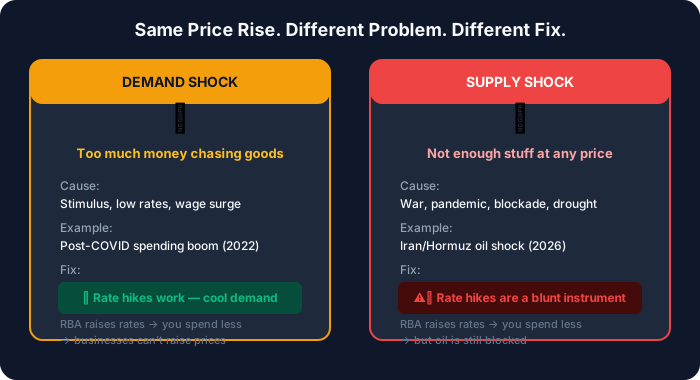
The RBA can reduce how much you're willing to spend — but it cannot make more oil appear. It cannot reopen a shipping route. It cannot un-drought a farm.
Worse: by cooling demand through rate hikes, the RBA risks throwing people out of work and tipping the economy into recession — all to fight an inflation problem that originated overseas and was never within its control.
What Actually Happened in Australia: 2022–2024
The truth of the 2022–24 inflation surge is that it was both.
The supply side: COVID-19 disrupted global shipping and manufacturing. Russia's invasion of Ukraine spiked commodity prices globally. Energy, grain, and fertiliser costs soared.
The demand side: Australia's fiscal response to COVID was large and well-targeted. Household savings were high. When restrictions lifted, Australians went out and spent — hard. Labour markets tightened. Some businesses raised prices beyond what their own cost increases justified.
The RBA — like most central banks — chose to hike aggressively. The ABS Monthly CPI Indicator peaked at 8.4% year-on-year in December 2022 (the headline quarterly CPI peaked slightly lower at 7.8% for the same quarter), and the cash rate climbed from 0.10% to 4.35% over 18 months.
Did it work? Inflation has since dropped, so in one sense yes. But the debate among economists about whether the RBA over-tightened — punishing mortgage holders for an oil shock they had no part in creating — is very much ongoing. Remember: economists are often wrong, and that includes the ones making the decisions.
A History Lesson in Three Oil Shocks
This isn't the first time the world has been here.
1973 — OPEC Embargo: Arab oil-producing nations cut supply to Western countries. Crude oil prices quadrupled — from about $2.90 to $11.65 per barrel in a few months. Western central banks hesitated, knowing rate hikes couldn't create more oil. They delayed tightening, then pivoted to stimulus. The result was a decade of stagflation: high inflation and high unemployment simultaneously. Only Paul Volcker's brutal rate hikes from 1979 — pushing the Fed funds rate to 20% — finally broke it.
2022 — Russia-Ukraine: Russia's invasion removed a major commodity supplier from global markets. Energy prices in Europe hit extraordinary levels. Central banks worldwide responded with aggressive hikes. Growth slowed. Inflation eventually moderated, but the tightening also slowed hiring and crushed household budgets.
2026 — Iran: Which brings us to today.
Right Now: The Strait of Hormuz and Australia's Vulnerability
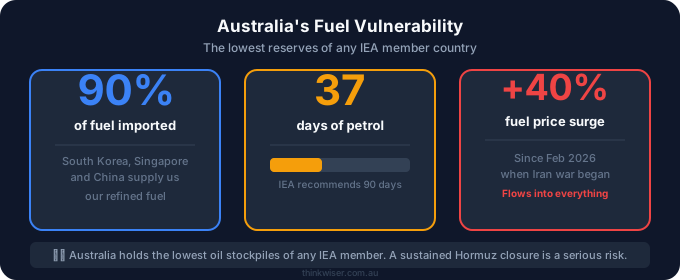
On 28 February 2026, US and Israeli forces launched a military campaign against Iran. Iran responded by choking the Strait of Hormuz — the narrow waterway through which approximately 20% of the world's oil and LNG passes every day. Commercial transits collapsed by more than 90%.
Brent crude surged from around $72 per barrel in late February to a peak near $119 in March. A brief ceasefire pulled prices back toward $92. Then, on 12 April, Trump announced a US Navy blockade of Iranian ports — and crude jumped back above $103/bbl. Australian petrol prices have risen roughly 40% since late February — from around $1.22/L to above $2.00/L at the pump.
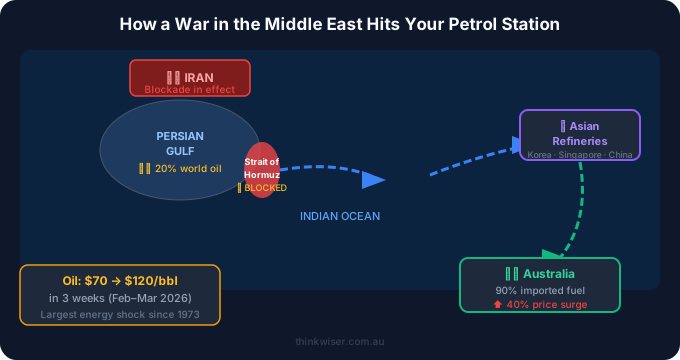
Here's why this hits Australia harder than most:
- Australia imports approximately 90% of its refined petrol and diesel — mostly from refineries in South Korea, Singapore, Japan, and Malaysia, which themselves rely on Middle Eastern crude
- Australian domestic crude production covers only around 5.6% of demand
- Australia holds the lowest oil stockpiles of any IEA member country: roughly 36 days of petrol and 32 days of diesel — well below the 90-day IEA obligation we've failed to meet since 2012
That last point is significant. We are not a country that can ride out a prolonged supply disruption.
The RBA's Impossible Choice — Again
Inflation was already sitting above the 2–3% target when the RBA raised the cash rate by 25 basis points to 3.85% on 3 February 2026 — three weeks before the Iran war began. That hike was a response to demand-side pressure. Then the oil shock hit.
Now Westpac is forecasting the RBA will hike again — to 4.85% by August 2026 — as oil prices flow through into everything from petrol to food delivery to manufacturing costs.
Here is the RBA's dilemma, drawn plainly:
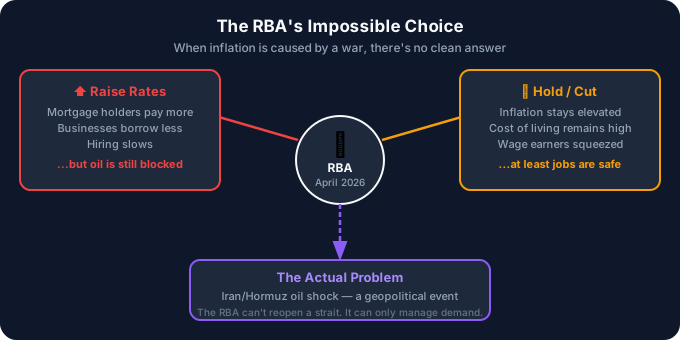
If the RBA raises rates: Mortgage holders pay more. Businesses borrow less. Hiring slows. The economy cools. But petrol is still expensive, because there's still a war.
If the RBA holds or cuts: Inflation remains elevated. Cost of living stays high. Wage-earners feel squeezed. But at least people keep their jobs.
There is no version where everyone wins. This is what the dual mandate actually means in practice: the RBA has to choose whose pain is more acceptable.
What This Means for You
If you're a small business owner or a ThinkWiser client, here's the practical takeaway:
On mortgages: Variable rates are already sitting around 5.80%, and more hikes are likely. It's worth modelling what your repayments look like at 6% and 7%. Not to panic — but to plan. Our mortgage calculator lets you stress-test both.
On business costs: Fuel price rises flow through to delivery, logistics, and manufactured goods. If your supply chain touches transport, expect cost pressure. Build that into your pricing now, not later.
On investment timing: Higher interest rates make borrowing for capital investment more expensive. If you've been considering equipment or property, factor in that the cost of debt may stay elevated through 2026.
On the broader picture: This is a supply shock. The RBA can blunt consumer demand, but it cannot reopen the Strait of Hormuz. The resolution of oil prices depends more on geopolitics than on monetary policy — which is a humbling reminder that economics, for all its elegant models, operates in a world shaped by forces it cannot control.
The Bottom Line
The RBA raises interest rates to reduce demand and cool inflation. In a demand-driven economy, this works. In a supply shock, it's a blunt instrument that causes collateral damage without fixing the underlying problem.
The 2022–24 hike cycle had elements of both. The 2026 Iran shock is much more purely a supply problem — which puts the RBA in an almost impossible position.
The models don't have a clean answer to this. The data will tell us later whether the right call was to hike aggressively or hold and wait. Probably some combination of both — calibrated perfectly in hindsight.
That's the honest truth about monetary economics. It's less science, more navigation under uncertainty. Which is why the people making these decisions deserve more credit than they get — and more scrutiny too.
If you want to talk through what rising rates mean for your business or mortgage position, book a free call with our team — we do this every week.
This post is general information only and does not constitute financial advice.
